
By KIMBERLIE QUITASOL
www.nordis.net
BAGUIO CITY — Despite the recorded damages on vegetable farms in the region after the onslaught of Typhoon Maring (Kompasu), the prices of temperate vegetables dropped according to the price monitoring of the Department of Agriculture-Cordillera Administrative Region (DA-CAR).
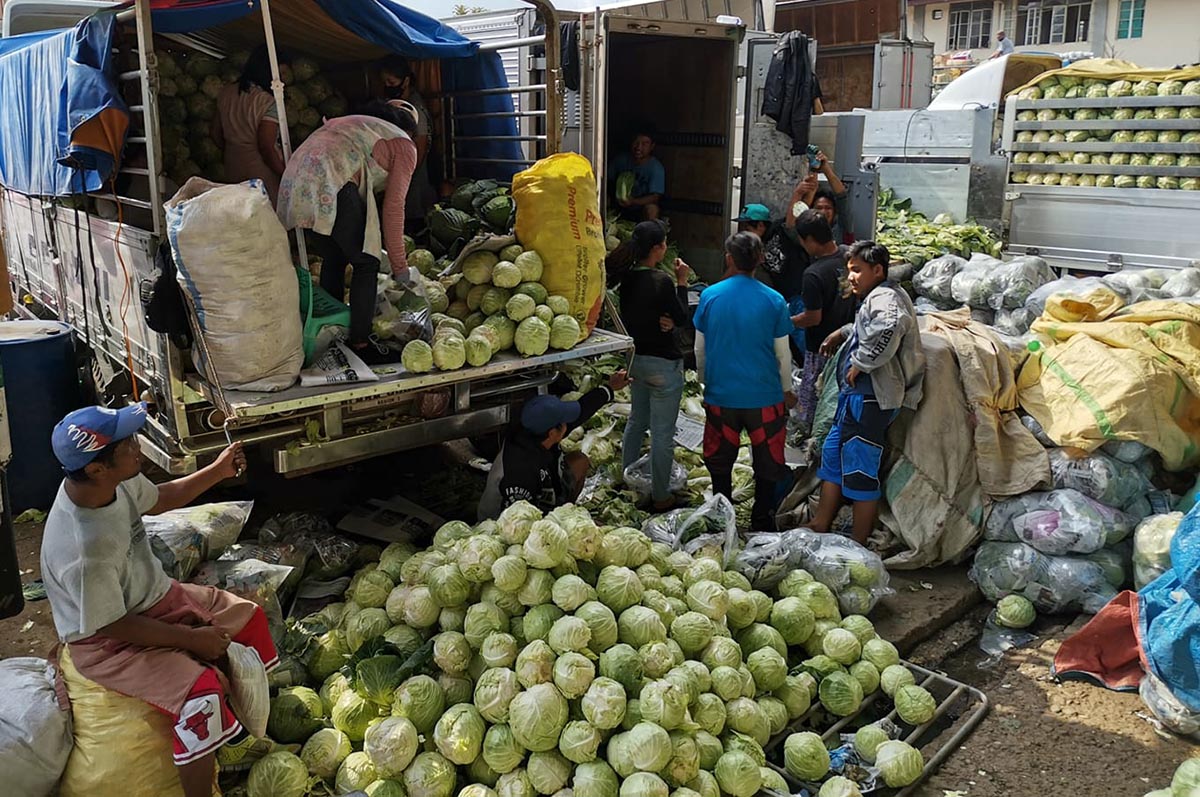
The wholesale price of cabbages today, October 15, at the Benguet Agri-Pinoy Trading Center (BAPTC) is P22 per kilogram compared to the P34 per kilo on October 12. Carrots cost P50 a kilo on October 12 but dropped to P27.50 per kilogram today. Wombok prices also dropped from P18 per kilo to P7.50.
Potatoes, however, recorded a slight increase from P60 per kilo to P62.
As of 10 AM today, Maring’s reported damage to agriculture in the region amounts to P212.7 million. The total damages for high-value crops, which include temperate vegetables, amount to P31.3 million.
Highland Vegetable Farmers Multipurpose Cooperative Manager Agot Balanoy said newly planted crops suffered the most damage. She explained that the typhoon did not affect the harvest much since mature ones withstand heavy rains and strong wind.
Balanoy further said landslides along the main roads caused delays in the transport of vegetables, but roads were opened in less than 24 hours, allowing the supply flow to resume.
“We did not expect an increase in prices of vegetables considering that the delay in transportation and damages to crops were not that big because Maring did not stay long unlike the Habagat (Southwest Monsoon) that brought non-stop rains for over a month,” she added.
Hoping on debt
Balanoy said farmers have no other recourse but to borrow money to finance the rehabilitation of their farms while waiting for government assistance. She shared that during Maring’s onslaught, farmers were already sending text messages, asking to apply for the cooperative loan.
December is among the peak season for temperate vegetables. Balanoy said the demand usually doubles during the period. “The holidays give farmers hope to earn more and be able to pay their debts,” she said.
But seeing no end yet to the pandemic, she said farmers fear they might produce more than the market demand. She added that Christmas is usually the time people spend more to celebrate and buy presents. However, with the limited economic activities and many remaining unemployed, the celebrations would not be as grand as they used to be.
She recalled that demand for vegetables was low during the first year of the pandemic. She also mentioned that prices of vegetables increased because the production also decreased after two typhoons hit the region during that period.
“But pandemic or not, whether high or low demand, vegetable production does not stop,” she said.
Holiday supply
According to Balanoy, most of the crops destroyed are set for harvest by December, in time for the holidays. However, she assured that farmers could produce enough vegetables for the Christmas season as long as no typhoons and other calamities hit their farms.
“They (farmers) have already started replanting, replacing their damaged crops,” she said.
“It would be nice if they receive assistance like free fertilizers, plastic covers and other farm inputs now. But from experience, government assistance would take time because it must undergo a process,” she added.
She underscored that affected farmers also need funds to replant and grow their crops. # nordis.net