By Elliot Dimasuhid
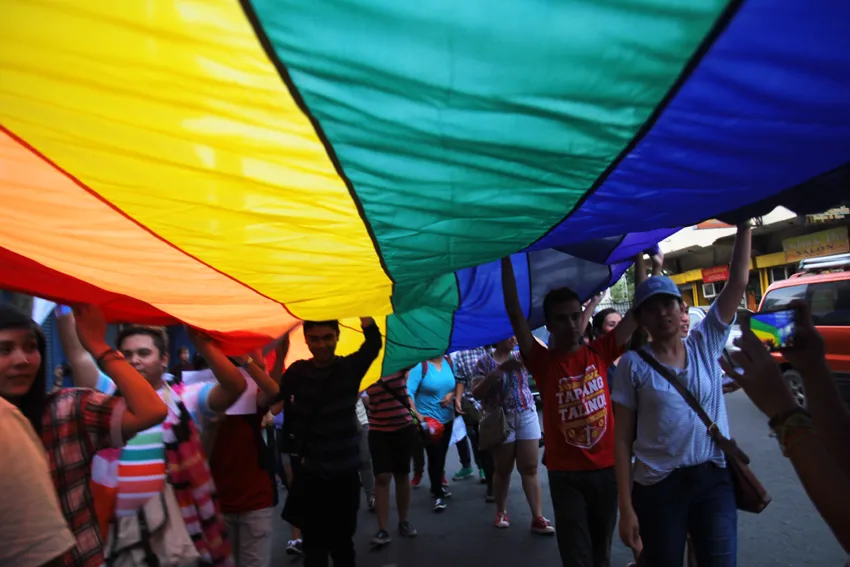
As calls for acceptance and equality resonate in every pride march, the battle for respect for the LGBTQ+ needs to be won.
Schools have become such battlegrounds. Educational institutions are responsible for providing safe learning environments for all regardless of sexual orientation and gender identities. But can they do so when homophobia is still condoned under the pretense of harmless entertainment? How can students fully participate in their school’s academic and formative environment when outdated gender binary-affirming policies are a barrier?
Dress code and hair policies
Rika Hokayu, a Grade 12 student at the Notre Dame of Midsayap College (NDMC) who identifies as a transwoman, expounds on the cost of being different in her school. “As a transgender student, I feel unaccepted because I am forced to cut my hair, [they] still consider me as a male student, and cross-dressing is also prohibited,” she expressed her discontent.
Ms. Rika pointed out that the hair-length limits prevented transwomen students from expressing their authentic selves. Across several secondary schools in the Philippines, assigned males at birth must undergo a “barber’s cut” or be forbidden to let their hair grow past the ear.
Trans students are also placed in a difficult situation due to gendered dress code policies. Providing a secure, inclusive atmosphere where transgender students are allowed to dress following their preferred gender expression is essential to upholding the highest education standards. Rika stands by this, “School policies should be updated with an open mind, especially for the good of everyone, not just for the sake of the school’s image.”
Last August 19, the Department of Education reaffirms the implementation of the existing Department Order 32, s. 2017, which provides guidelines for gender-responsive basic education across the country, in line with the opening of classes for School Year 2022-2023 and the gradual resumption of in-person classes. However, properly acknowledging one’s gender identity remains one of the numerous challenges and misrepresentations trans individuals experience in their educational journey.
Underlying issues
Although steps have been taken to help the trans community live better in light of their challenges, Pat Delton Cervantes, a Grade 12 student at Mapúa Malayan Colleges Mindanao (MMCM) in Davao, feels these have not yet been sufficient. He feels there is widespread ignorance of concepts relating to sexuality and gender expression.
“Perhaps just the fact that cisgender people tend not to be as educated on how deeply it actually affects transgender people when they say certain things. For example, I told my teachers and classmates I didn’t want to be referred to as a girl and my birth name. Still, I’ve heard people call me by my birth name, no matter how many times I repeatedly ask them not to. Unfortunately, I’m not very good at confrontation, so I never said anything, but my friends always do for me,” Pat said.
Despite how trivial they may appear to others, these problems can significantly impact a person’s self-image and mental and emotional health.
Rika says fighting transphobia is a long way to go.
“Transphobia isn’t new to me, especially to those older generations who aren’t open-minded and well-educated. I have experienced transphobia, not from my classmates, friends, and teachers but from the academic councils. I have fought for my rights as a trans student to consider my gender expression and let my hair [be] as it is. But they still disregard my request, and I don’t feel safe at all, especially [in] a school where mockery and disrespect are tolerated,” she said.
Then recently, her school’s basketball team posted on their Facebook page their cross-dressing stunt in which many – from the students to people within and outside the institution – express their discomfort and calls for reform in the student policies in terms of inclusivity enforced within the school.
In a statement, Bea Ducao, the Supreme Student Government (SSG) President of NDMC, condemned the use of cross-dressing as a form of comedic act, pointing out that the students’ failure to “uphold every part of the school’s core values” may be seen here.
“What’s embarrassing is this kind of act is being tolerated, and when you try to call them out, they would tell you that you’re being a ‘KJ’ (Killjoy) or say ‘Tanan nalang big deal.’ I think everybody is up for an inclusive community that’s safe for everyone, so why don’t we try to be a bit sensitive and be more careful as to what we are about to post, especially if you deemed something as entertaining when in fact, it is not,” she added.
“It isn’t entertaining [or] funny to me because I think it’s disrespectful; disrespect connects to bullying, and bullying is a form of violence. A lot of people have called them out for their violence, and they chose to ignore [it]. I don’t feel safe, but I won’t let myself suffer,” Rika added.
Roots of LGBTQ+ discrimination
Being a member of the LGBTQ+ community has long been associated with immorality because of Spanish machismo and conservative Catholic influences. This has caused Filipinos to reject their heritage and cast doubt on once-respected gender-fluid religious figures. The homophobic and transphobic attitude that this tragic past has left behind still exists, despite the numerous progressive initiatives within the Philippine Catholic church. It’s no wonder there seems to be a lack of awareness of SOGIE (Sexual Orientation, Gender Identity and (Gender) Expression) among Filipinos, given that the educational system is based on such influences.
People must address the roots of ignorance on these issues by educating themselves in formal and informal contexts. Discussions on SOGIE and LGBTQ+ issues are crucial for enabling learners and educators to stay up to the times and better grasp the community’s struggles. Schools must adapt their rules to be more SOGIE-sensitive for students to manifest their learning effectively.
Above all, it is essential for the government to take an active part in the development of laws to guarantee that transgender individuals are safeguarded anywhere. Reforms like the SOGIESC Equality Bill are essential for defending trans women’s rights and preventing gender identity-based violence and discrimination. Moreover, the country is gradually moving on the right path with the recent approval of the SOGIESC Equality Bill in the Senate Committee to eradicate all forms of discrimination. To free the LGBTQ+ community from the chains of violence and oppression, it will be necessary to overcome the difficulty of unlearning heteronormativity. The SOGIESC Equality Bill remains at the forefront of this cause.
Transgender individuals endure some of the most challenging lives since they are frequently the victims of injustice and mistreatment. These people battle against being refused what must be basic human decency to live freely as their authentic selves. When everything is said and done, it’s achingly disheartening how a country handles one of the most marginalized people; the collective suffering that a whole community has gone through creates a gloomy, dreary mosaic of sorrow. It serves as a reminder of how far empathy can go to help people set aside their prejudices from the past and instead focus on compassion and empathy.
Elliot Dimasuhid is a freelance illustrator who uses art to provide dashes of color, a writer, and a journalist. He’s a HUMSS student and the Editor-In-Chief of The Blue Bridge at Ateneo de Davao University Senior High School for AY 2022-2023. He loves crafting narratives with impact, whether it’s about queer youth, culture, or social issues.