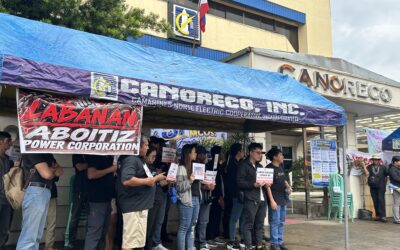
Over the years, some of my peers, photojournalists especially, have taken note – some with delight, others with derision – of the sheer volume of young people documenting the big protest actions.
Campus journalists, many of them, but also young people generally, armed with phones, DSLRs, and mirrorless cameras, often outrunning the vets, sometimes stepping on our toes, blocking our field of vision, and generally crowding us out.
In those situations, the unwritten rule used to be that veteran photographers literally and figuratively called the shots: from the marches to the obligatory photo ops to the effigy- or flag-burning. Not anymore. These days, the young journos rule.
It used to irritate me a bit, but, as I said, I have come to accept this as a good thing. The general idea is that these young people have further amplified the message – perhaps even taking it to places and people that independent and alternative media content has never reached before. These young people, of course, speak the language of their generation, visually and psychically, and they are now at the frontlines of the information war, or, more aptly, the war against disinformation.
The recent upsurge in student and youth actions – first, against the flood control corruption scandals, and then the Gen Z walkouts protesting the Pax Silica Initiative and the Trump visit – are testament to their relative success. These are successes they must build on and develop, and I have no doubt they will.
This, of course, is what gives us the kuyas/ates and titos/titas of the past, the former frontliners whose hair is greying and whose joints ache after just a few meters of back-walking while shooting the marchers. Media and journalism practice have changed so wildly over the past two decades that I think alternative and independent voices, especially those of young people, should now have a much better chance – simply by virtue of their numbers – of influencing public discourse, steering conversations, challenging narratives, and opening up the Overton window. Better chances, perhaps, than we, their Gen X and millennial forebears, ever had.
Take, for instance, how many of my mainstream media colleagues, mostly from the older generation, framed the recent protests against Pax Silica and the Trump visit during last week’s ASEAN Summit, both in their captions and in their reports. Frankly, I would not fault them for this. After all, they merely learned from their own elders, their own editors, and their own organizations, which, out of habit and tradition, are simply doing what they have always done, and doing their jobs to the best of their abilities.
Specifically, what caught my attention was the framing of the violent dispersals – unprecedented, even, in recent history – of the anti-Pax Silica protests in Liwasang Bonifacio in Manila and in Cebu, as well as in Sucat, Muntinlupa, where participants in the Southern Tagalog caravan were merely passing through that fateful day, November 14.
These were described as “clashes,” “standoffs,” “girian,” or mere outbursts of emotion on both sides. This is a generally ahistorical, decontextualized, and simply inaccurate way of describing what happens during dispersal operations, particularly violent ones, carried out by the police and other authorities. In context, protest actions are fundamentally exercises in power imbalances: one group represents the powerless (their very powerlessness being the reason for their protest), while the other represents the empowered – the forces of power whose interests and positions the protests threaten.
Logistically, the imbalance is even more evident. The police have their batons and shields, and some – as we have seen in these protests – even carry firearms, both long and short. Cebu-based photojournalist Jacq Hernandez, a friend and someone from my generation, I would say, documented an instance of a policeman threatening to draw his firearm as police dispersed protesters. In Liwasang Bonifacio, on November 17, the day Trump arrived in Manila, SWAT teams carrying long firearms were seen milling about the area.
When thousands of protesters positioned themselves to march toward the ASEAN Summit venue, SWAT members were menacingly stationed on the flyover overlooking the crowd, their long firearms – I couldn’t tell if they were the traditional M16s or more modern variants – strapped to their chests.
Media coverage of these protests has traditionally been woefully lacking in context. What is the historical significance of an American president visiting the country? Why has the progressive movement historically protested such visits by American heads of state? What is the history of Philippine-American diplomatic relations? The pundits regularly paraded on public affairs programs have been woefully unable or unwilling to provide these contexts.
The most glaring example is Richard Heydarian, who argues that the protests are directed against the industrialization opportunities that Pax Silica supposedly offers. His hot take is a woefully naive remark for anyone who has even casually studied successive Philippine administrations’ policies on foreign direct investment and economic zones. Pundits like Heydarian present Pax Silica as an opportunity in and of itself, entirely detached from its broader context: the present, violent expansionist project of the American empire and its competition with the would-be Chinese empire.
To be sure, some independent and alternative voices, such as IBON Foundation, occasionally seep into the public conversation. But, on the whole, they remain on the margins and in the minority when it comes to mainstream discourse.
Which brings us back to the youth, who, of course, have the vigor, curiosity, and the opportunity to critically examine these issues and independently study their contexts. The youth, of course, are not alone. The progressive movement will continue to do its part. But though they remain a minority in the population at large, the youth, with their progressive ideas and boundless energy, are now at the frontlines.
They have, perhaps more than at any other time in recent history, an opportunity to push for meaningful change – not only in media practice but also in the marginalized communities, where policies like Pax Silica and the country’s continued subordination to imperialist interests are matters of life and death.
As for me and my generation, we will carry on for as long as we can – and follow the youth’s lead.