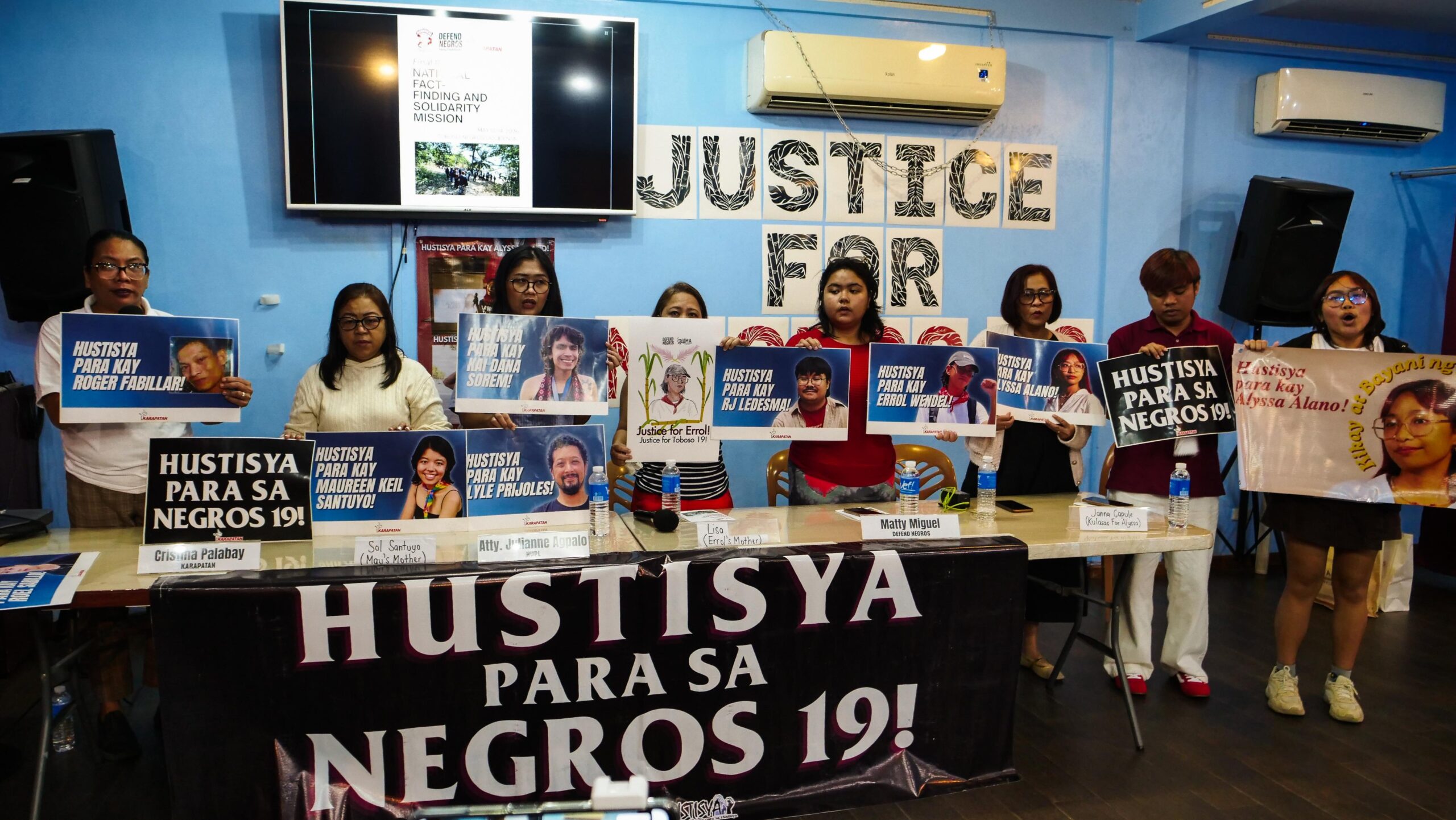
A national fact-finding mission said the Philippine Army committed serious violations of international humanitarian law in the killing of 19 people in Toboso, Negros Occidental, including nine civilians, disputing the military’s claim that all those killed were armed communist rebels.
The National Fact-Finding and Solidarity Mission released its findings during a press briefing Aug. 19 in Quezon City, as the country observed International Humanitarian Law Month.
The report was based on a May 13-14 investigation into the April 19 military operation in Barangay Salamanca, Toboso town.
The mission said 10 of those killed were members of the New People’s Army, while nine were civilians who did not take part in the fighting. It said soldiers failed to distinguish between civilians and combatants and fired at people retreating through an exposed fishpond.
Cristina Palabay, secretary general of Karaptan, said the Toboso killings were the gravest mass-casualty case involving alleged IHL violations that the group had documented in recent years.
“This is the single, the biggest single mass casualty incident involving international humanitarian law violations that we have documented and looked into sa mga nakaraang taon,” Palabay said. (“This is the single, the biggest single mass casualty incident involving international humanitarian law violations that we have documented and looked into in recent years.”)
“Ito po ang pinakamalala,” she added. (“This is the worst.”)
Palabay said the case required continued scrutiny and a sustained push for justice. She also pointed to the prohibition against a “no quarters given” policy, saying such a policy is illegal under Republic Act 9851 and the Geneva Conventions.
“Yung na-incapacitate na kahit combatant o civilian ay dapat binubuhay. In fact, dapat binibigyan ng pansamantalang lunas kung injured. Hindi pinapaulan na ng bala, definitely,” Palabay said. (“Those who have been incapacitated, whether combatant or civilian, should be kept alive. In fact, they should be given medical aid if injured. They should definitely not be showered with bullets.”)
The Philippine Army had reported a “series of clashes” involving troops of the 79th Infantry Battalion and said all 19 fatalities were armed NPA members. Brig. Gen. Ted Dumosmog, commander of the 303rd Infantry Brigade, had described those killed as “armed combatants.”
The fact-finding mission said witness testimony, physical evidence, and preliminary autopsy findings cast doubt on the military’s account.
According to the report, an initial clash occurred between about 3 and 4 a.m. in Sitio Sinugmawan. Alleged NPA members and civilians then retreated toward a fishpond in nearby Sitio Plarinding.
Soldiers entered Plarinding at about 6 to 7 a.m. One group moved to a hill overlooking the fishpond while another approached at ground level. A second shooting incident occurred at about 9 a.m.
Residents said those fleeing had to cross waist-deep muddy water in an exposed area with little or no cover. Investigators found that soldiers occupied elevated and ground-level positions surrounding the fishpond.
The report said the circumstances left the armed NPA members unable to effectively fight back and rendered them hors de combat, or incapable of continuing to participate in hostilities.
The mission accused soldiers of failing to distinguish between civilians and combatants and of attacking fighters who were no longer in a position to fight.
It described the killings as a “massacre” and said community accounts and physical evidence indicated that the incident “was not a legitimate military operation.”
The mission also said the circumstances raised concerns that some victims may have been subjected to summary execution or excessive lethal force after they were wounded or otherwise unable to defend themselves.
Drone footage, autopsies raise questions
The report cited the death of NPA commander Roger Fabillar as one of the cases raising questions over the Army’s encounter narrative.
The mission said drone footage taken before his death showed Fabillar alive, unarmed and submerged in the fishpond. It said he appeared to have been hors de combat before the military later reported that he had been “killed in an encounter.”
The mission said the circumstances indicated that Fabillar may have been extrajudicially executed rather than killed in combat.
Preliminary autopsy findings also raised questions over how several of the victims died.
Forensic pathologist Dr. Raquel Fortun examined the remains of Alyssa Alano, Maureen Santuyo, Lyle Prijoles, Kai Sorem and a male cadaver initially identified as Errol Wendel.
Three of the five bodies had multiple fatal gunshot wounds, according to the report. Fortun also noted multiple gunshot wounds from behind, which the mission said raised questions about the Army’s account of an hours-long armed encounter.
The report said Alano suffered a gunshot wound to the leg that caused fatal bleeding. It said she did not sustain an immediately fatal wound but died without receiving medical treatment.
Families demand answers
Families of those identified by the mission as civilians said their children’s work with communities should not have made them targets.
Sol Santuyo, mother of Maureen, said helping other people “is not a crime” but “an act of compassion.”
“Tumutulong sila; bakit sila pinatay? Kailangan po namin ang sagot sa mga katanungang ito. Buhay ng mga anak namin ang kinuha nila,” Santuyo said. (“They were helping people. Why were they killed? We need answers to these questions. They took the lives of our children.”)
Four months after the killings, Santuyo said the families were still waiting for satisfactory answers and questioned whether red-tagging could justify the deaths.
“Apat na buwan na,” she said. (“It has been four months.”) “Sapat ba na dahilan ito para karumal-dumal silang patayin?” (“Is this sufficient reason for them to be brutally killed?”)
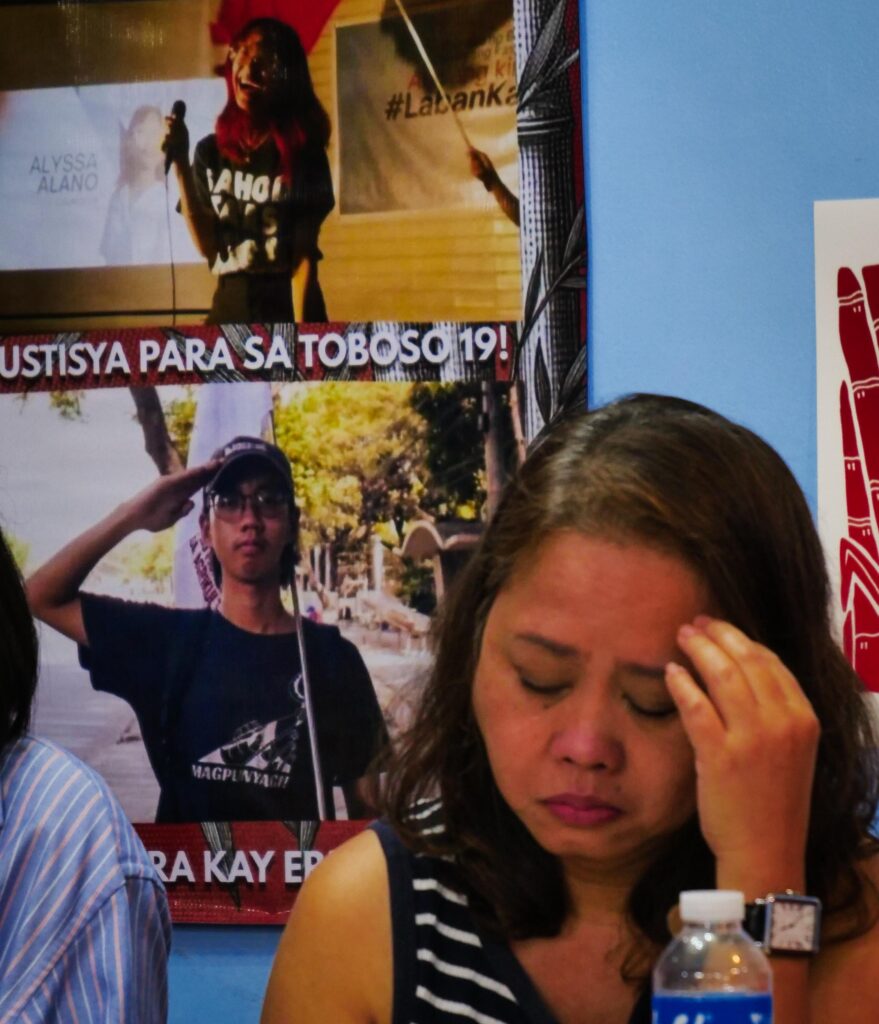
Lisa, mother of Errol Wendel, said the failure to return her son’s remains compounded the pain of his death.
“Brutal ang ginawa nila” (“What they did was brutal”), Lisa said, adding, “Mas brutal ang ginawa na hindi na ibigay sa amin ang katawan niya, sobrang sakit” (“What was even more brutal was that they did not give us his body. It was extremely painful”).
Lisa said she struggled to sleep as she thought about her son’s body being left in the water.
The mission documented irregularities in the handling and identification of the remains. Fortun found that a cadaver released as Errol did not match his physical description. Investigators later learned that Errol’s remains had apparently been released to Merliza Caramihan, mother of another fatality, Joeross Caramihan.
Investigators also found bullet casings and other physical evidence still at the two reported encounter sites.
The report said Buklod Kapayapaan, a group affiliated with the National Task Force to End Local Communist Armed Conflict, had been allowed into the sites before police investigators processed them. The mission said the presence of uncollected evidence raised concerns over the preservation and integrity of the crime scenes.
Killings amid land struggle
The report also placed the April killings against a continuing struggle over land in Sitio Sinugmawan.
Farmers there formed the Hacienda Bedonia Farmers and Farmworkers Association in November 2025 after learning they could qualify as agrarian reform beneficiaries of an 18-hectare property their families had cultivated since the 1970s.
They petitioned the Department of Agrarian Reform for coverage of the property in January and began cultivating a four-hectare portion through a bungkalan, or collective farming action, in February.
Members of the association later said they suspected that allegations of an NPA takeover of the property, reportedly raised shortly before the April 19 operation, may have contributed to the events leading to the killings. The report did not establish a direct causal link.
Shiela Alano, Alyssa’s mother, questioned the use of allegations of NPA membership against activists and people documenting conditions in marginalized communities.
“How can we trust the AFP when they can so blatantly get away with killing anyone just by labeling them as NPA?” she said.
Alano said activists, journalists, and researchers were being silenced for seeking to understand the lives of marginalized sectors, including Negros farmers who work long hours for low pay while remaining without land of their own.
“Bakit sa bansa natin pinapatahimik niyo ang mga aktibista, journalists, researchers, especially when it’s about knowing the lives of marginalized sectors kagaya ng mga farmers sa Negros na sobra-sobra silang magtrabaho and yet underpaid, walang sariling sakahan kahit sila ang nagbubungkal ng lupa,” she said. (“Why, in our country, do you silence activists, journalists and researchers, especially when their work is about understanding the lives of marginalized sectors, such as farmers in Negros who work extremely hard and yet are underpaid and have no land of their own even though they are the ones tilling it?”)
“Wala sila Alyssa sa Negros kung maayos ang kabuhayan nila doon. Wala sila sa Negros kung binibigay ng gobyerno ang nararapat para sa mga maralita na pinagkaitan ng bulok na sistema,” she added. (“Alyssa and the others would not have been in Negros if people there had decent livelihoods. They would not have been in Negros if the government gave the poor what they are entitled to after being deprived by a rotten system.”)
Residents interviewed by the mission identified Alano, Wendel, Santuyo, community journalist RJ Ledesma, Sorem, Prijoles and Roel Sabillo as civilians who had previously visited the community. They said they had never seen them carrying firearms.
The families of two minors, identified in the report as 15-year-old “Melissa” and 17-year-old “Ron,” also denied allegations that they were NPA members.
The Communist Party of the Philippines acknowledged that 10 of the fatalities were NPA members and said the remaining nine were civilians, according to the report.
Military operation displaced hundreds
The mission also documented the impact of the operation on residents of Barangay Salamanca.
Residents said soldiers searched at least 24 houses and questioned civilians about alleged NPA members. Some reported being held at gunpoint.
A male resident detained with a 14-year-old boy and the boy’s mother said he saw soldiers firing toward the fishpond. He also said a soldier struck him on the shoulder with a rifle butt and that a commanding officer warned him against filing a case.
About 800 residents fled their homes between April 19 and 22. Residents said the military operation prevented them from reaching the river and fishponds, disrupting their sources of food and livelihood.
Children who participated in a psychosocial activity after the operation described fear and anxiety from the gunfire. Some hid under their beds and stayed inside their homes.
The May 13-14 fact-finding mission was organized by Manindigan Negros, Defend Negros and Karapatan and involved 117 participants from local, national and international organizations. Investigators interviewed about 30 residents, inspected the reported encounter sites, and gathered physical evidence.
The mission called for criminal and administrative charges, where warranted, against military personnel involved in the operation and their immediate superiors.
It also demanded that the families and their lawyers be given access to the Army’s mission order, drone footage, after-operation reports, and other records related to the killings.
The mission called for further independent forensic examinations and autopsies, humanitarian and psychosocial assistance for affected communities, and the withdrawal of the 79th Infantry Battalion and other military forces from Toboso while investigations continue.
It also urged the abolition of the NTF-ELCAC through the repeal of Executive Order No. 70 and the rescission of Memorandum Order No. 32, saying the measures had facilitated prolonged military operations in civilian communities and contributed to human rights violations.