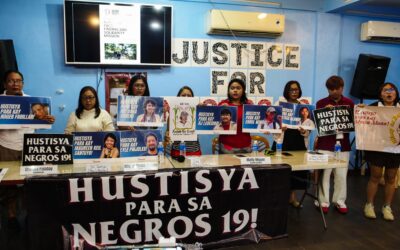

Press freedom advocates warned that the prolonged detention of community journalist Frenchie Mae Cumpio reflects a broader pattern of legal repression in the Philippines, as a Tacloban court prepares to issue a verdict in her case on Jan. 22.
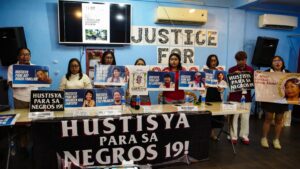
The warning was raised during a media briefing at the University of the Philippines, nearly six years after Cumpio and Catholic lay worker Marielle Domequil were arrested during a February 2020 raid in Tacloban City.
They face non-bailable charges of illegal possession of firearms and explosives and financing terrorism, which have kept them in detention. The court’s ruling will cover the remaining cases after earlier charges were dismissed.
In October 2025, the Court of Appeals reversed a civil forfeiture case involving funds seized during the raid, finding “no factual and legal basis” for the forfeiture.
In November 2025, murder and attempted murder charges against the two were also quashed due to discrepancies in identification.
Defense warns of ‘manufactured narratives’ and coerced testimonies
Atty. Josalee Deinla of the National Union of People’s Lawyers said the cases must be viewed from a wider pattern of how counterterrorism laws are used against journalists, human rights defenders, and civil society groups.
“They are actually situated within a larger pattern, a pattern of using the law to chill, silence, or discipline dissent, or otherwise to use the law as a form of social control,” the lawyer said.
She said cases are often built through what she described as a “playbook of repression,” relying on coerced testimonies and recycled allegations.
“Some of these statements are extracted under pressure, sometimes without counsel, and sometimes after violent coercion,” Deinla said, citing that in one recorded case, “we know that a military asset emerged after her mother was abducted and kept in detention by military personnel.”
“That is not law enforcement. That is the manufacturing of fabricated narratives,” she said.
“We have seen how the names repeat, how the allegations are cut and pasted, and how these narratives keep appearing in various cases, almost verbatim, with only the names of the accused swapped out,” she added.
Deinla cited a study conducted with the Council for People’s Development and Governance that documented a “371 percent increase” in financing terrorism cases between 2023 and 2024, which she linked to the government’s push to comply with standards set by the Financial Action Task Force.
“People are punished before any final finding,” she said, pointing to the use of asset freezing and civil forfeiture as forms of financial repression.
Shrinking civic space
National Union of Journalists of the Philippines (NUJP) officials said the case of Cumpio unfolds amid a wider pattern of threats and attacks against journalists.
The group recorded 216 attacks against members of the media under the Marcos administration so far, noting that the figure remains a running total as documentation and verification continue.
Altermidya Network, one of the convenors of the Free Frenchie Mae Cumpio and Free Tacloban 5 campaigns, documented overr 50 attacks against independent and community journalists since July 2022.
Advocates said the data underscores the heightened risks faced by journalists, particularly those working in community and alternative media.
Community journalism under threat, advocates say
UP College of Media and Communication Dean Diosa Labiste said Cumpio, an alumna of the University of the Philippines Tacloban and former editor of the student publication UP Vista, embodies the importance of protecting community journalism.
“A journalist should not be censored, harassed, or jailed,” Labiste said. “Journalism thrives best in conditions of freedom.”
International press freedom groups said the case has drawn sustained global attention and raised questions about the Philippine government’s commitment to press freedom.
Beh Lih Yi of the Committee to Protect Journalists said Cumpio “has spent more than half of her twenties imprisoned on bogus charges designed to silence her critical reporting.”
She said Cumpio’s case highlights the heightened risks journalists face globally, noting that reporters are working in one of the most dangerous periods for the profession, as governments across political systems increasingly jail journalists and restrict the public’s right to information.
Akriti Saraswat of Free Press Unlimited described the case as “emblematic” with an “impact that reaches far beyond the Philippines,” adding that “good journalism was not born in newsrooms” but in communities.
Aleksandra Bielakowska of Reporters Without Borders (RSF) said the prolonged detention of Cumpio illustrates a deeply entrenched pattern of abuse.
“The sheer amount of this absurdity shows how deeply systemic this has become in the Philippines and how local authorities, including the military and police, are very often targeting independent voices,” Bielakowska said.
She cited RSF’s latest global assessment, noting that RSF ranked the Philippines 116th out of 180 countries in the 2025 World Press Freedom Index, classifying it as a country where conditions for journalists are difficult.
“With Frenchie in prison, the only journalist currently detained in the country, it will be very difficult to reverse this trend in the future,” she said.
As the Jan. 22 promulgation approaches, advocates urged that the proceedings be conducted without intimidation, following reports that the Armed Forces of the Philippines had expressed intent to attend the hearing.
“The public and the media must be able to witness justice unfolding without fear,” Deinla said.
Advocates also reiterated calls for the repeal of the Anti-Terrorism Act and the Terrorism Financing Prevention and Suppression Act. They warned that the laws’ broad provisions continue to be used against journalists and civil society groups.
“This trial is not only about one journalist,” Bielakowska said. “It is a critical test for press freedom in the Philippines.”